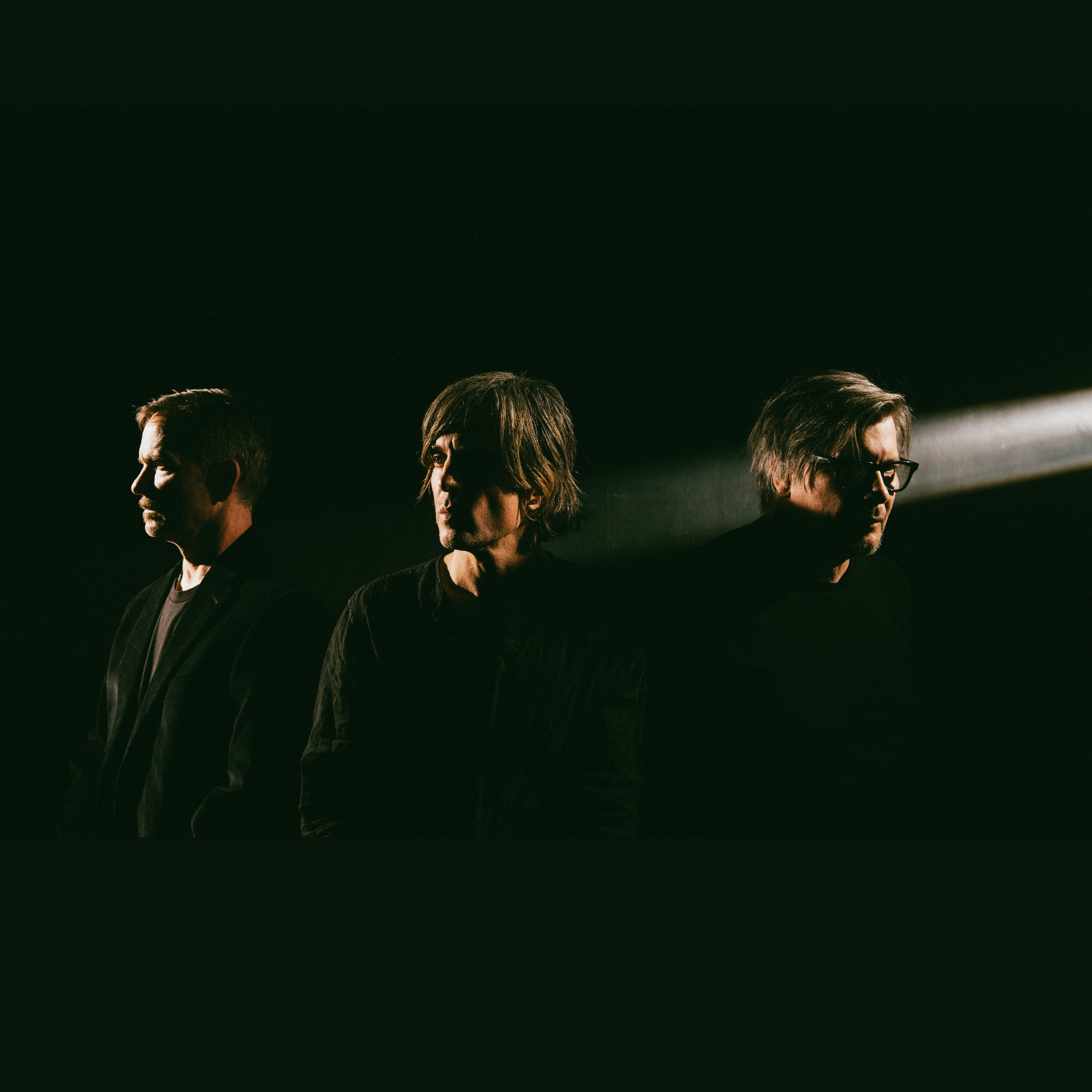
Failure
Sunday
For a band so closely associated with weight, density, and mass, Failure have spent much of their career writing about what happens when those things fall away. Bodies drift. Memories fragment. Signals distort. Gravity fails. But even after 30 years, the hugely influential trio of Ken Andrews, Greg Edwards, and Kelli Scott are still following the sound wherever it leads, even when it’s uncomfortable, unfamiliar, or disruptive. Location Lost, the band’s seventh album and their fourth since improbably reuniting in 2014 after a 17-year-hiatus, doesn’t arrive as a victory lap or a nostalgia exercise. Instead, it sounds like a band actively negotiating where — and who — they are now. “It’s very different,” Edwards says plainly of the nine-song follow-up to 2021’s Wild Type Droid.
“There are sounds and parts that really don’t have any precedence within the Failure world.” That sense of divergence is inseparable from how Location Lost came together. Following Wild Type Droid, Failure completed a long-gestating documentary (Every Time You Lose Your Mind) and concert film (We Are Hallucinations) that chronicled their history, drug-marred breakup, and improbable second life playing for a newfound younger and more diverse audience. The process was exhaustive, and revealing. Almost immediately after finishing the film, Andrews suffered a serious back injury that required surgery.
The operation was technically successful; the recovery was not. “It kind of messed up my brain chemistry somehow,” he says. “It wasn’t just physical recovery.” By late 2024, Failure were finally able to begin recording in earnest. As with Wild Type Droid, Andrews, Edwards, and Scott rented a studio and spent weeks improvising together as a trio, recording hours of unfiltered material without overthinking where it might lead. But the dynamic inside those sessions had shifted. Andrews, still recovering, felt creatively unmoored. “I was participating, but my editorial side just wasn’t working,” he says. “Luckily, Kelli and Greg were able to step up and take the lead in terms of confidently saying, ‘that was a good idea.’ We had a lot of material, but I didn’t know what it was.” Edwards noticed it too. “Ken was there in actual physical bodily presence,” he says, “but I don’t feel like he was really able to get lost in the music or become part of the flow of that creative part of the record. Even if you’re the most well-adjusted.
Musically, that reconnection manifests as the most varied record Failure has ever made. There are simpler, more driving songs than the band has historically favored, two ballads (an anomaly in their catalog) and moments that feel almost willfully alien. “I was just following what felt good,” Andrews says. “More of the editorial side of my brain was turned off. It was not calculated, but there’s something about it that’s a little more accessible..” Throughout, Location Lost delivers dose after dose of Andrews, Edwards and Scott’s utterly unique creative and instrumental interplay, from the warning bell-like guitar chimes on propulsive opener “Crash Test Delayed,” to the elastic, bass-driven groove of “Halo and Grain” and the grinding, methodical wall of sound on “Solid State,” which wouldn’t have sounded out of place on 1996’s all-time-classic Fantastic Planet.